
When Facebook became a big thing, I avoided it.
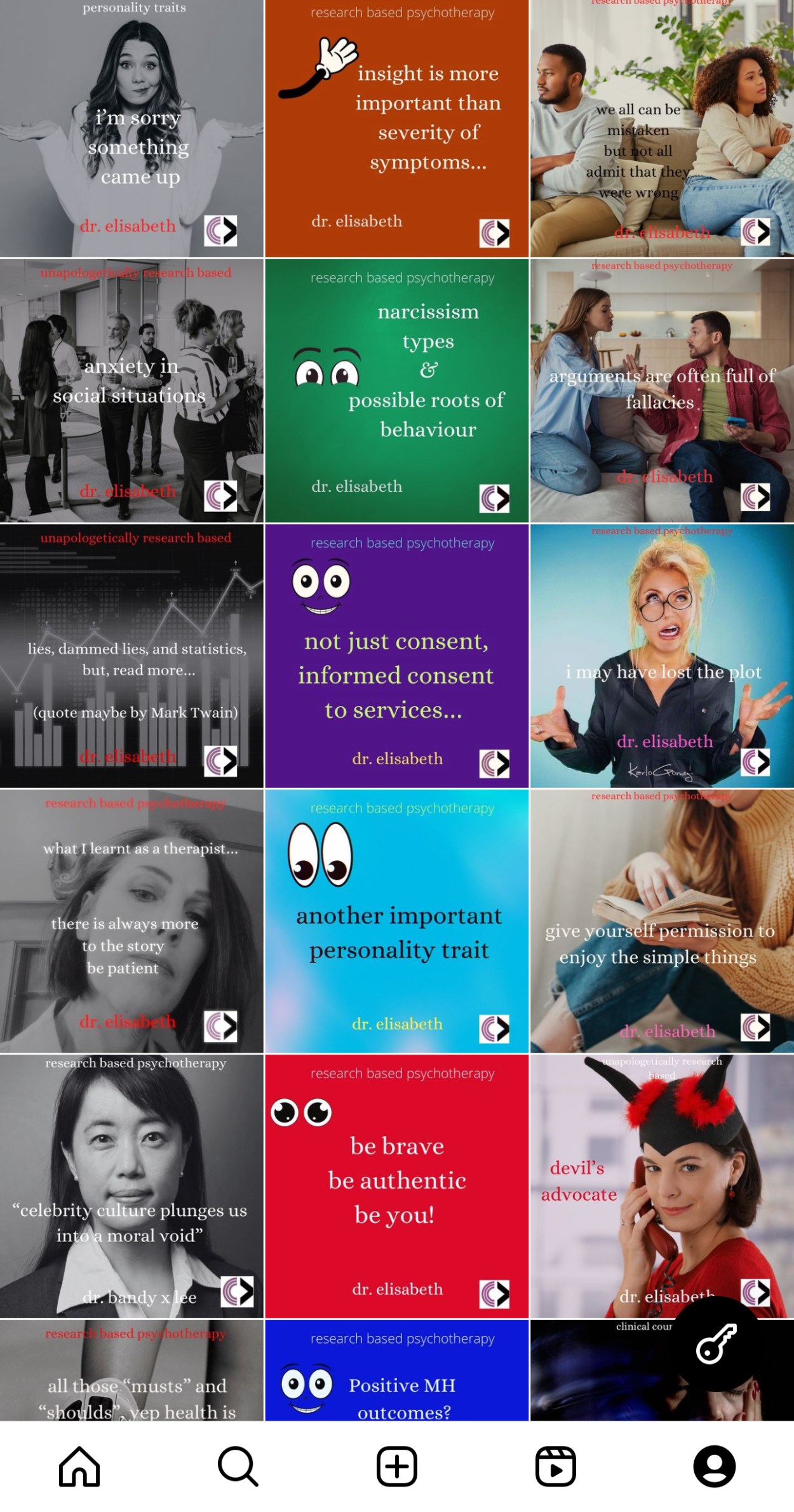
But…a few years ago, I joined Instagram as I realized that I wanted to experience directly what it was about, and the best way to do this, is to join them.
After a few years, I am fine-tuning the IG posts and make my account a bit more esthetically appealing. I am still learning and only using a few of the many creative options available.
My posts have an overall theme and are about accountability, insight, and openness. At the end of every post, I added a disclaimer stating that IG posts are not independently fact checked and are no alternative for one-on-one counselling therapy.
I am not reposting anything, and I only use quotes of people who have not been overly quoted (or mis-quoted) already, but when I do, I write a few lines about this person and its relevance to my message.
Due to using the brief options of posting on IG, my writing of articles and Blog posts have suffered, which is not due to a lack of ideas, but more out of laziness as it is so much faster to write a paragraph and use an app to add a nice picture.
The opportunities are endless and anyone these days can be creative with the options, but it takes away from accurately formulating a thought and providing a background and sources. This comment, I feel is relevant, as what I realized is how fast and how easy it has become to create something appealing.
With all the analytic tools, we know what the followers want, and it is not hard to figure out what works to get tons of likes. Reposts of course, of a cliché quote accompanied by a photo of an attractive young actor, a general statement about something positive (mostly self-care and nature), with a popular tune at the background, are the most popular.
What also works well, is the TikTok idea of short videos and those that do well are funny and very brief and I must admit that when I feel down, watching some funny short clips, tend to lift my mood.
The topics I care deeply about, however, are about human behaviour, (thoughts, feelings and actions, and the foundation on which our knowledge is based, which is on recorded, collected, and measured observations. I respect all types of research, as long as it is ethically done, and the authors disclose conflicts of interests. These posts won’t be the highest ranking in popularity and that is OK, as it is not my intention to become a content creator who is paid for endorsements.
When hammering on respectful behaviour, insights, and accountability, I have no issues with stating that I have learnt a lot over the years from my experience and my studies. I recognize the flaws in my own thinking and actions, and am still trying to exercise a level of compassion when looking back at my childhood, teen and adolescent years when I was oblivious and lacking in confidence and maturity to acknowledge my shortcomings.
Children gradually and in a nurturing and safe environment go through moral developmental stages that are correlated with their cognitive capacities. Children learn about respect, fairness, compassion, and empathy and seem to have this inborn inkling about what is right and what is wrong.
I was fortunate to be initially trained as an early childhood educator and during my studies I was introduced to the stages of physical, social-emotional, and moral development. Later, when studying lifespan development, I started to understand the importance of both nature and nurture, the life adversaries that keep people behind or stuck, but also the resilience in people and the potential to free themselves from whatever held them back.
I have been writing about narcissism, not as a diagnosis, but as a set of personality traits (https://scheepersblog.com/2024/02/21/understanding-the-personality-traits-of-narcissism/), and I am concerned as contributing factors to the development of narcissistic behaviour are based on both nature and nurture and our society, which is influenced by the values of its members.
I wonder what we are really teaching when we attempt to educate young people on values such as respect, fairness, compassion, empathy, ethics, morality, honesty and authenticity, and at the same time, reward people with attention and admiration who have craftly engineered fake media reputations, who manipulate their followers and are unapologetically greedy and entitled.
I cringe when I see a well-made short video of a therapist with professional make-up and hair, talking about self-worth. The ultimate level of manipulation, I feel is using quotes about respect while tagging the sellers of the clothing, jewelry, or make-up you wear.
So, no it is not social media, but the manipulation used by many, and social media has made it easy to reach a lot of people, who are easily influenced by all the promises made to them about what will make them happy.
 Thoughts & Commentary
Dear Dr Elisabeth,
I read your entire post and learnt a great deal about your work in developmental psychology, which is one of the most important domains in behavioural science. Indeed, we share a lot of the same concerns that you have highlighted so well here. Social media, and increasingly, advanced artificial intelligence, have become the accelerant and magnifier of some of the most problematic aspects of human transactions and behaviours, as discussed in my post metaphorically entitled “📈🌆 Growing Humanity with Artificial Intelligence: A Sociotechnological Petri Dish with Latent Threats, Existential Risks and Challenging Prospects 👨👩👦👦🤖🧫☣️” published at
I welcome your feedback there. May you have a lovely weekend!
Yours sincerely,
SoundEagle
LikeLike
Thank you for reading my post, and sharing my concerns.
I will read your post!
Elisabeth
LikeLiked by 1 person
I really like your down-to-earth attitude, your honesty and openness. Thank you!
LikeLiked by 1 person
Thank you !
LikeLiked by 1 person
Great insight, Elizabeth. I’ve always been dubious about “national” (read: commercial) therapists, especially those on the airwaves. Even when I felt they were sincere in their attempts to explain or breakdown an issue or affliction, I always worried about the guests who appeared on those shows. To me they were pawns to a larger effort at what ended up being ratings and earnings. When those same celebrity professionals moved over to social media, I wondered how they could possibly offer meaningful assistance. Old whiskey in new bottles, to borrow a phrase. It’s not just therapists or mental health professionals, of course. I’m seeing the same things with so called personal finance advisors, who ultimately are hawking some kind of book or service. Buyer beware! I will check out your IG page. You I already know are sincere! Great to see your excellent posts again here. – Marty
LikeLiked by 1 person
Thank you, Marty,
I wrote a short post about the importance of remaining small on social media.
When creative and talented people become too big, they often lose that level of creativity that made them interesting, as now they have to offer the same, with small variations to meet expectations and unfortunately please many as they don’t want to ruffle any feathers and get cancelled!
Thank you for your reply!
LikeLiked by 1 person
A few years ago, I was invited at a t.v. show. I obviously was no commercial success. I think the host’s values did not align with mine. I was not re-invited. (I wrote about it in my post on Valentine’s day).
A blessing in disguise :).
LikeLiked by 1 person
Definitely!
LikeLiked by 1 person